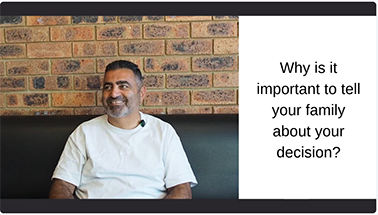
Welcome to our WeCare videos. These short videos have been made by the Lebanese Community Advisory Panel and answer commonly held questions about organ donation and registration. Click the button at the bottom to watch them on the next page.
Click to hear about this research or click to read the Participant Information Sheet
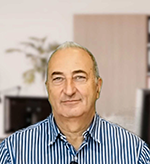
Please listen to Dr David Abi-Hanna tell you what this research is about and why it is important.
show description
David is a gastroenterologist and has been working in the southwest of Sydney since 1998. He has a special interest in endoscopy and uses his skills to diagnose and treat many gastrointestinal disorders including cancers. He is based at Liverpool Hospital and has private rooms nearby. David grew up in Lebanon and came to Australia at the age of 17 to continue his studies. He feels privileged to have experienced life in both his native Lebanon as well as his beloved Sydney and Australia more generally. David has been involved in many health committees and is particularly proud of his work during the COVID pandemic, encouraging his fellow Lebanese Australians to get vaccinated. Although not directly involved in transplantation, he was keen to contribute to the WeCare project, knowing how important organ donation is to health outcomes in those needing transplants.
Our names are Associate Professor Gail Moloney, Pierre Georges, Professor Marie Hutchinson and Maddison Norton. You will find the names of the other members of the Lebanese Advisory Panel underneath each video on the video buffet page. This study is aimed at increasing awareness about organ donation and registration in the Lebanese community.
Together, members of the Lebanese Advisory Panel have co-created short videos about organ donation and registration for the Lebanese community. The videos address some of the issues that people may not know or have concerns about. It is important that we understand what members of the Lebanese community think about the videos. We are really interested in what you have to say!
You can choose how many videos you would like to watch. There are some anonymous questions to answer at the start and after each of the videos. You will also be given an opportunity to register your organ donation decision on The Australian Organ Donor Register - this is entirely up to you.
While you will not be paid to participate in this research, there are a few potential benefits. You will have the opportunity to learn about organ donation and registration by watching videos made by people in your community. The findings of this research will also support strategies for engaging with the Lebanese community and other culturally diverse communities about organ donation and registration.
This research has been assessed as low risk. However, if any of the questions or videos make you feel distressed, you are free to skip that question or withdraw from the study completely. If you need additional support about any of the issues these discussions raise, please contact:
Lifeline Australia on 13 11 14
Beyond Blue on 1300 224 636
Embrace Multicultural Health http://embracementalhealth.org.au
The Transcultural Mental Health Centre NSW
https://www.dhi.health.nsw.gov.au/transcultural-mental-health-centre
Your responses to the questions are completely anonymous, and you will not be asked to provide any personal information. The findings of this study may be published in a peer-reviewed journal. All data collected in this study will be stored safely and securely at Southern Cross University for a minimum of 5 years after publication.
Your participation in this research is completely voluntary. If you choose to withdraw by closing the web browser, the answers you have already submitted may be used in the analysis.
If you would like to receive a summary of the results when this research is finished, please email gail.moloney@scu.edu.au.
If you have any questions about this research, please contact:
Associate Professor Gail Moloney
Faculty of Health (Psychology)
Southern Cross University
Coffs Harbour Campus
Email: gail.moloney@scu.edu.au
This study adheres to the Guidelines of the ethical review process of Southern Cross University and the National Statement on Ethical Conduct in Human Research. Whilst you are free to discuss your participation in this study with the researcher contactable on gail.moloney@scu.edu.au, if you would like to speak to an officer of the University not involved in the study, you may contact the Ethics Officer on email ethics.lismore@scu.edu.au. All information is confidential and will be handled as soon as possible.
This research has been approved by the Human Research Ethics Committee at Southern Cross University. The approval number is 2022/098.
Before you watch the videos, could you please answer six short questions? Your answers will be anonymous, so we won't know who you are, but they will help us know a little about the people who watched the videos.
Could you please tell us?
2. Your gender
3. Your cultural group (e.g. Lebanese, Lebanese Australian)
4. Your religious or spiritual group
5. Your age
6. Your postcode
7. In Australia, organ donation intentions are recorded on the national Australian Organ Donor Register (AODR)
Select which best describes you?
8. Would you mind telling us how you found out about the WeCare Project?
Could you please tell us a little more? E.g. If it was a community event, which event? If it was a personal contact, who sent it to you?
Your responses will be automatically saved
Please watch as many videos as you would like. Once you open a video and watch it, a few questions will appear underneath. Your answers are anonymous and will help us understand what our community thinks about the videos
Pierre Georges and Camille Issa
show description
Pierre is the Tissue Donor Coordination Team Leader at the NSW Tissue Bank (NSW OTDS), bringing over 26 years of dedicated service to the field of organ and tissue donation. Pierre lived part of his childhood (age of 5 to 15) in Lebanon, forming great appreciation for its rich culture and traditions before he returned to Australia in 1990. Pierre is passionate about mentoring and community involvement. He coaches at Merrylands Soccer Football Club, where he inspires young people to recognise and achieve their potential—both on and off the field. Camille was born in Lebanon in 1970 but moved to Australia when he was only 6 years old. Camille went to school in the Cumberland area, studied to be a hairdresser & barber after school and has worked for his community for 40 years. He is passionate about his job and hopes one day to teach the younger generation by teaching at TAFE.
Chris Abi-Hanna
show description
Born in Sydney, Chris is of second generation Lebanese heritage, which he is extremely proud of. He returns often and is a Lebanese citizen, and wishes to spend much longer there in the future. He is currently completing a Masters of Professional Psychology at Notre Dame University, and wishes to help people in the field of mental health and disorders in clinical settings. His passions include music festivals, kibbeh nayeh, camping and travel.
Pierre Georges
show description
Pierre is the Tissue Donor Coordination Team Leader at the NSW Tissue Bank (NSW OTDS), bringing over 26 years of dedicated service to the field of organ and tissue donation. Pierre lived part of his childhood (age of 5 to 15) in Lebanon, forming great appreciation for its rich culture and traditions before he returned to Australia in 1990. Pierre is passionate about mentoring and community involvement. He coaches at Merrylands Soccer Football Club, where he inspires young people to recognise and achieve their potential—both on and off the field.
Vicky Georges and Christy El-Khoury
show description
Victoria is an actress and writer born and raised in Western Sydney. She is of proud Lebanese heritage, whose passion for the cause of organ donation stems from hearing about her father's work with the NSW Tissue Bank. She has dreams of writing and performing stories close to her experiences, hoping to capture the powerful spirit of Lebanese-Australian immigrants. Christy is an intensive care pharmacist at St George Hospital with a strong interest in research and improving patient outcomes. She is passionate about advocating for patients’ rights and delivering high-quality care. Christy has a natural curiosity and enjoys trying new things, from baking creative desserts and playing tennis to travelling and exploring history through diverse cultures and experiences.
Dr. David Abi-Hanna
show description
David is a gastroenterologist and has been working in the southwest of Sydney since 1998. He has a special interest in endoscopy and uses his skills to diagnose and treat many gastrointestinal disorders including cancers. He is based at Liverpool Hospital and has private rooms nearby. David grew up in Lebanon and came to Australia at the age of 17 to continue his studies. He feels privileged to have experienced life in both his native Lebanon as well as his beloved Sydney and Australia more generally. David has been involved in many health committees and is particularly proud of his work during the COVID pandemic, encouraging his fellow Lebanese Australians to get vaccinated. Although not directly involved in transplantation, he was keen to contribute to the WeCare project, knowing how important organ donation is to health outcomes in those needing transplants.
Mary Georges and Christy El-Khoury
show description
Mary is a secondary science and mathematics teacher at Cerdon College in Merrylands. Born and raised in Australia by Lebanese immigrants, she is of proud Lebanese heritage and is blessed with a wonderful husband and six beautiful children. She enjoys teaching and inspiring others to be good servants of humanity. Christy is an intensive care pharmacist at St George Hospital with a strong interest in research and improving patient outcomes. She is passionate about advocating for patients’ rights and delivering high-quality care. Christy has a natural curiosity and enjoys trying new things, from baking creative desserts and playing tennis to travelling and exploring history through diverse cultures and experiences.
Pierre Georges and Dr. David Abi-Hanna
show description
Pierre is the Tissue Donor Coordination Team Leader at the NSW Tissue Bank (NSW OTDS), bringing over 26 years of dedicated service to the field of organ and tissue donation. Pierre lived part of his childhood (from to 5 to 15 years) in Lebanon, forming great appreciation for its rich culture and traditions before he returned to Australia in 1990. Pierre is passionate about mentoring and community involvement. He coaches at Merrylands Soccer Football Club, where he inspires young people to recognise and achieve their potential—both on and off the field. David is a gastroenterologist and has been working in the southwest of Sydney since 1998. He has a special interest in endoscopy and uses his skills to diagnose and treat many gastrointestinal disorders including cancers. He is based at Liverpool Hospital and has private rooms nearby. David grew up in Lebanon and came to Australia at the age of 17 to continue his studies. He feels privileged to have experienced life in both his native Lebanon as well as his beloved Sydney and Australia more generally. David has been involved in many health committees and is particularly proud of his work during the COVID pandemic, encouraging his fellow Lebanese Australians to get vaccinated. Although not directly involved in transplantation, he was keen to contribute to the WeCare project, knowing how important organ donation is to health outcomes in those needing transplants.
Georges Family
show description
Pierre, his daughter Victoria, and his father John, who was born in Lebanon and migrated to Australia in 1970, have an intergenerational conversation about the numerous views regarding organ and tissue donation within the Lebanese community.
Please click on the arrow to watch the video.
Can you please answer the following questions
To what extent do you think:
The video included something positive about organ donation
The video included something you did not know about organ donation
To what extent do you think other people in your community would be interested in this video?
Your responses will be automatically saved
Please listen to this short audio on How to register your organ donation intention.
Audio in English by Pierre Georges
show description
Pierre is the Tissue Donor Coordination Team Leader at the NSW Tissue Bank (NSW OTDS), bringing over 26 years of dedicated service to the field of organ and tissue donation. Pierre lived part of his childhood (age of 5 to 15) in Lebanon, forming great appreciation for its rich culture and traditions before he returned to Australia in 1990. Pierre is passionate about mentoring and community involvement. He coaches at Merrylands Soccer Football Club, where he inspires young people to recognise and achieve their potential—both on and off the field.
If you would like to read about registration in another language, please click here.
Address of the Holy Father John Paul II to the 18th International Congress of The Transplantation Society (2000). Read the Address
A Fatwa regarding organ donation by the Grand Mufti of Australia. Read the Fatwa
A video of support by Sheikh Jamal-Ud Din El- KiKi . Please watch Watch the video on youtube
Would you like to register your organ donation intention now?
You can register your intention by choosing which organs and tissue to donate OR by saying no to donation through Medicare using your MyGov account.
You can register your intention to donate all your organs and tissue at DonateLife
You can print a paper AODR form to register your intention by choosing which organs and tissue to donate OR to say no to donation. (Choose this option if you are on a visa and don't have medicare)
Registering your donation intention is not binding. You can change your registration or remove yourself from the AODR at any time through Medicare or on the paper AODR form.
Please take the time to talk with your Family about your donation intention.
Would you mind telling us if you did register your organ donation intention today?
Would you like to comment?
Your responses will be automatically saved