Conversations about Organ Donation & Registration
Welcome to the WeCare app. You will find two sets of videos about organ donation and registration on this app.
- Our Community Produced videos answer commonly held questions; these videos were written, acted and produced by the Community Advisory Panel specifically for the Bangladeshi community.
- Our Donation Specialist Doctor videos answer specific medical questions that people from the community have asked on the app.
You can choose which videos you would like to watch using the buttons at the bottom of this page.
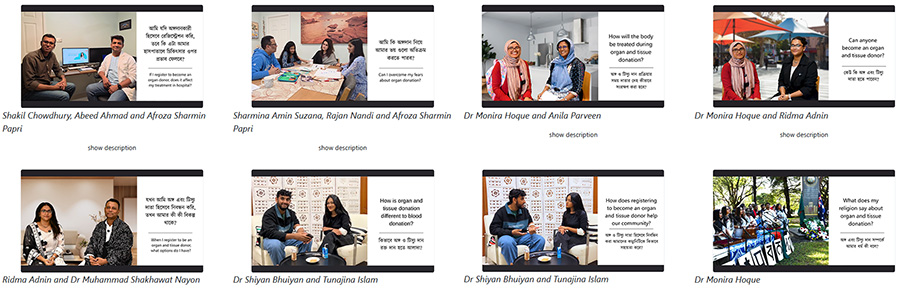
Please listen to Dr Monira Hoque tell you what this research is about and why it is important.
Videos for the Bangladeshi community about organ donation and registration
Introduction
Our names are Associate Professor Gail Moloney, Dr Monira Hoque, Professor Marie Hutchinson and Maddison Norton. You will find the names of the other members of the Bangladeshi Advisory Panel underneath each video on the video buffet page. This study is aimed at increasing awareness about organ donation and registration in the Bangladeshi community.
What is this research about?
Together, members of the Bangladeshi Advisory Panel have co-created short videos about organ donation and registration for the Bangladeshi community. The videos address some of the issues that people may not know or have concerns about. It is important that we understand what members of the Bangladeshi community think about the videos. We are really interested in what you have to say!
What will I need to do?
You can choose how many videos you would like to watch. There are some anonymous questions to answer at the start and after each of the videos. You will also be given an opportunity to register your organ donation decision on The Australian Organ Donor Register - this is entirely up to you.
What are the possible benefits of taking part?
While you will not be paid to participate in this research, there are a few potential benefits. You will have the opportunity to learn about organ donation and registration by watching videos made by people in your community. The findings of this research will also support strategies for engaging with the Bangladeshi community and other culturally diverse communities about organ donation and registration.
What are the possible risks and disadvantages of taking part?
This research has been assessed as low risk. However, if any of the questions or videos make you feel distressed, you are free to skip that question or withdraw from the study completely. If you need additional support about any of the issues these discussions raise, please contact:
Lifeline Australia on 13 11 14
Beyond Blue on 1300 224 636
Embrace Multicultural Health http://embracementalhealth.org.au
The Transcultural Mental Health Centre NSW
https://www.dhi.health.nsw.gov.au/transcultural-mental-health-centre
What will happen to the information about me?
Your responses to the questions are completely anonymous, and you will not be asked to provide any personal information. The findings of this study may be published in a peer-reviewed journal. All data collected in this study will be stored safely and securely at Southern Cross University for a minimum of 5 years after publication.
What will happen if I decide to withdraw?
Your participation in this research is completely voluntary. If you choose to withdraw by closing the web browser, the answers you have already submitted may be used in the analysis.
Can I hear about the results of this research?
If you would like to receive a summary of the results when this research is finished, please email gail.moloney@scu.edu.au.
Who can I contact if I have any concerns about the project?
If you have any questions about this research, please contact:
Associate Professor Gail Moloney
Faculty of Health (Psychology)
Southern Cross University
Coffs Harbour Campus
Email: gail.moloney@scu.edu.au
This study adheres to the Guidelines of the ethical review process of Southern Cross University and the National Statement on Ethical Conduct in Human Research. Whilst you are free to discuss your participation in this study with the researcher contactable on gail.moloney@scu.edu.au, if you would like to speak to an officer of the University not involved in the study, you may contact the Ethics Officer on email ethics.lismore@scu.edu.au. All information is confidential and will be handled as soon as possible.
Ethics Approval
This research has been approved by the Human Research Ethics Committee at Southern Cross University. The approval number is 2022/098.
Before you watch the Community-produced or the Donation Specialist Doctor videos, could you please answer six short questions? Your answers will be anonymous, so we won't know who you are, but they will help us know a little about the people who watched the videos.
Could you please tell us?
2. Your gender
3. Your cultural group
4. Your age
5. Your postcode
6. In Australia, organ donation intentions are recorded on the national Australian Organ Donor Register (AODR)
Select which best describes you?
7. Would you mind telling us how you found out about the WeCare Project?
Could you please tell us a little more? E.g. If it was a community event, which event? If it was a personal contact, who sent it to you?
Your responses will be automatically saved
Please watch as many videos as you would like. Once you open a video and watch it, a few questions will appear underneath. Your answers are anonymous and will help us understand what our community thinks about the videos
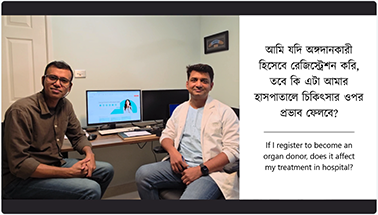
Shakil Chowdhury, Abeed Ahmad and Afroza Sharmin Papri
show description
Shakil is a Cloud Solution Architect specializing in secure enterprise cloud systems. He is acting the role of the medical doctor. Abeed, who is acting the role of the patient in the video, is a Data Analytics professional, avid reader, and community cricket coach. Abeed is also a regular blood donor with LifeBlood Australia. Afroza, who is singing in the video, is a respected Indian classical vocalist. She works for the NSW Department of Education and is a devoted mother of two.
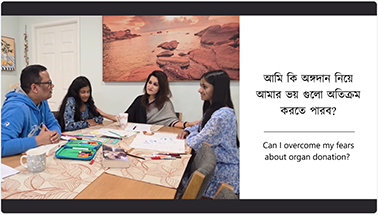
Sharmina Amin Suzana, Rajan Nandi and Afroza Sharmin Papri
show description
Sharmina is a registered pharmacist based in Sydney and a mother to a 24-year-old son. She enjoys literature, the arts, and travel. Rajan is a Senior IT Service Delivery Manager. He mentors children in the Bangladeshi community, nurturing their confidence and creativity in storytelling. Afroza, who is singing in the video, is a respected Indian classical vocalist. She works for the NSW Department of Education and is a devoted mother of two.
Dr Monira Hoque and Anila Parveen
show description
Monira is a research scientist at the NSW Tissue Bank (NSW OTDS). Born in Bangladesh, raised in South Africa and Australia, Monira is also passionate artist who enjoys teaching children about sustainable artwork. Anila is an Accountant at the Children’s Cancer Institute Australia. She is a passionate writer and has published three Bangla translated children’s books about the Australian Aboriginal Dreamtime.
Dr Monira Hoque and Ridma Adnin
show description
Monira is a research scientist at the NSW Tissue Bank (NSW OTDS). Born in Bangladesh, raised in South Africa and Australia, Monira is a passionate artist and enjoys teaching children about sustainable artwork. Ridma is an international student specialising in Early Childhood Education and Care. She also has a passion for music, drama and fine arts.
Ridma Adnin and Dr Muhammad Shakhawat Nayon
show description
Ridma is an international student specialising in Early Childhood Education and Care. She also has a passion for music, drama and fine arts. Shakhawat is an epidemiologist and a creative journalist and writer. He is also the Publications Secretary of Ekushe Academy Australia and runs his own youtube channel.
Dr Shiyan Bhuiyan and Tunajina Islam
show description
Shiyan has Bangladeshi parents, was born in New Zealand, and now lives in Sydney. Shiyan is a doctor specialising in Psychiatry and is passionate about challenging South Asian cultural stigmas related to mental illness. Tunajina has Bangladeshi parents, was raised in Botswana, and lives in Sydney. She is a marketing professional and volunteers for women’s empowerment, autism awareness, and refugee crisis work.
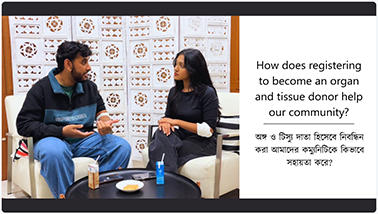
Dr Shiyan Bhuiyan and Tunajina Islam
show description
Shiyan has Bangladeshi parents, was born in New Zealand, and now lives in Sydney. Shiyan is a doctor specialising in Psychiatry and is passionate about challenging South Asian cultural stigmas related to mental illness. Tunajina has Bangladeshi parents, was raised in Botswana, and lives in Sydney. She is a marketing professional and volunteers for women’s empowerment, autism awareness, and refugee crisis work.
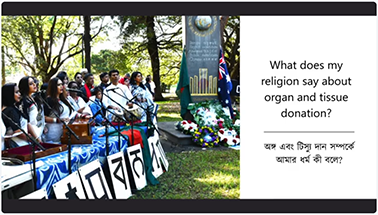
Dr Monira Hoque
show description
Monira is a research scientist at the NSW Tissue Bank (NSW OTDS). Born in Bangladesh, raised in South Africa and Australia, Monira is also passionate artist who enjoys teaching children about sustainable artwork.
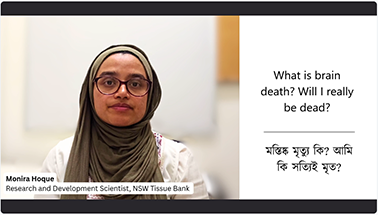
Dr Monira Hoque
show description
Monira is a research scientist at the NSW Tissue Bank (NSW OTDS). Born in Bangladesh, raised in South Africa and Australia, Monira is also passionate artist who enjoys teaching children about sustainable artwork.
Would you like to hear from some of our Advisory Panel members?
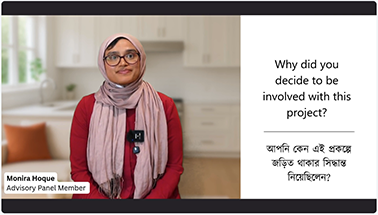
Dr Monira Hoque
show description
Monira is a research scientist at the NSW Tissue Bank (NSW OTDS). Born in Bangladesh, raised in South Africa and Australia, Monira is also passionate artist who enjoys teaching children about sustainable artwork.
Saquia Naz
show description
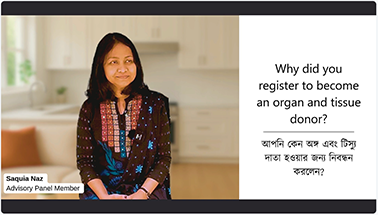
Saquia is a professional software engineer for Atlassian. She is also the recipient of a living kidney donation from her loving brother, over 15 years ago. This profoundly deepened her appreciation for family, friendship and the gift of life. The wants to make every moment count, being a loving wife and mother to a 21-year-old son.
Nehal Neyamul Bari
show description
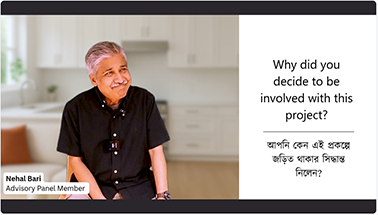
Nehal is a longstanding member of the Sydney Bangladeshi community. He is the founding president of the Ekushe Academy Australia (EAA) and an advocate for Bangladeshi history, heritage and language. Nehal is the pioneering coordinator for EAA's annual blood donation appeal since 1999.
Rakib Islam
show description
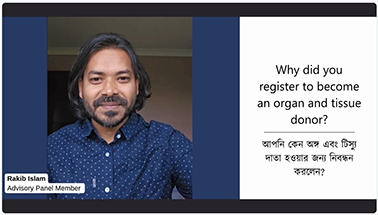
Rakib is a counsellor at Odyssey House NSW and runs his own private psychotherapy practice. He specialises in many areas such as trauma, adult ADHD and self-esteem. Rakib also runs a small digital audio-visual marketing production and book publishing business in Bangladesh.
Anila Parveen
show description
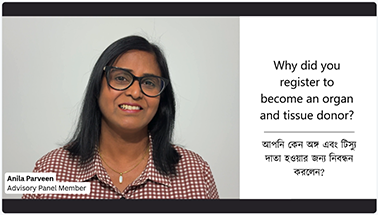
Anila is an Accountant at the Children's Cancer Institute Australia. She is a passionate writer and has published three Bangla translated children's books about the Australian Aboriginal Dreamtime.
Please click on the arrow to watch the video.
Please click on the arrow to watch the video.
Please click on the arrow to watch the video.
A Fatwa regarding organ donation by the Grand Mufti of Australia. Read the Fatwa
A video of support by Sheikh Jamal-Ud Din El- KiKi . Please watch https://www.youtube.com/watch?v=Qv-33GBWouw
Please click on the arrow to watch the video.
Please click on the arrow to watch the video.
Please click on the arrow to watch the video.
Please click on the arrow to watch the video.
Please click on the arrow to watch the video.
Please read Religious and Cultural support statements about Organ DonationCommunity resource Library
Please click on the arrow to watch the video.
Please click on the arrow to watch the video.
Please click on the arrow to watch the video.
Please click on the arrow to watch the video.
Please click on the arrow to watch the video.
Please click on the arrow to watch the video.
Please click on the arrow to watch the video.
Please click on the arrow to watch the video.
Please click on the arrow to watch the video.
Please click on the arrow to watch the video.
Your responses will be automatically saved
Can you please answer the following questions
To what extent do you think:
The video included something positive about organ donation
The video included something you did not know about organ donation
To what extent do you think other people in your community would be interested in this video?
Your responses will be automatically saved
Registering Your Organ Donation Intention
Please listen to this short audio on How to register your organ donation intention.
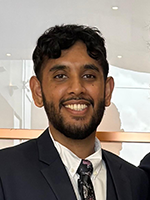
Audio in English by Dr Shiyan Bhuiyan
show description
Shiyan is a doctor specialising in Psychiatry and is passionate about challenging South Asian cultural stigmas related to mental illness.
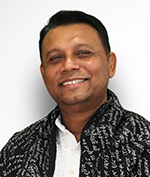
Audio in Bangla by Dr Shakhawat Nayon
show description
Shakhawat is an epidemiologist, creative journalist, and Publications Secretary at the Ekushe Academy Australia.
If you would like to read about registration in another language, please click here.
A Fatwa regarding organ donation by the Grand Mufti of Australia. Read the Fatwa
A video of support by Sheikh Jamal-Ud Din El- KiKi . Please watch https://www.youtube.com/watch?v=Qv-33GBWouw
Would you like to register your organ donation intention now?
You can register your intention by choosing which organs and tissue to donate OR by saying no to donation through Medicare using your MyGov account.
You can register your intention to donate all your organs and tissue at DonateLife
You can print a paper AODR form to register your intention by choosing which organs and tissue to donate OR to say no to donation. (Choose this option if you are on a visa and don't have medicare)
Registering your donation intention is not binding. You can change your registration or remove yourself from the AODR at any time through Medicare or on the paper AODR form.
Please take the time to talk with your Family about your donation intention.
Would you mind telling us if you did register your organ donation intention today?
Would you like to comment?
Your responses will be automatically saved
Questions from the Community, answered by a Donation Specialist Doctor
The WeCare App has had a wonderful response from the community. Thank you for your valuable comments on the videos. Many of you also asked other questions about organ donation and registration. We have worked with two Donation Specialist Doctors to provide answers.
Please click on the videos to watch Dr Ram Lakshmanan and Dr Michael Sutherland answer some of these questions or click on the written questions below to read the answer.
About Dr Ram and Dr Michael
Dr Ram is an Intensive Care specialist at Liverpool Hospital NSW, a Donation Specialist Doctor and a member of the SWS LHD Organ and Tissue Steering Committee.
Dr Michael Sutherland is a Donation Specialist Doctor with NSW Organ and Tissue Donation Service and an Intensivist at Coffs Harbour Base Hospital.
Dr Ram and Dr Michael have extensive expertise and knowledge in organ donation and registration, as well as firsthand experience facilitating end-of-life discussions with next-of-kin.


Additional questions answered by Dr Ram and Dr Michael
Consent begins with trying to find out what the patient's wishes would be regarding organ donation. They may already have registered on the Australian Organ Donor Register or have told a family member or a friend about their donation wishes. In all cases, close family members will be asked for their views on whether organ donation should proceed. The key person for this decision is the senior available next of kin. Every effort will be made to contact this person (which may involve international communication), and if this is not possible, the next senior next of kin available will be asked whether organ donation should proceed.
Yes, if you register to donate all or some of your organs and tissues, you will, and an organ donor card will be sent to you in the mail after you have registered on the Australian Organ Donor Register. You should also tell your family members and close friends that you have registered and that you have a donor card.
Your information will be stored in a secure national database. This database can only be accessed by authorised persons seeking to know your wishes in the event that you might be a potential organ donor after an accident or illness. You should also make an effort to inform close family and friends of your decision, as they may be the ones asked about that in the event of your death.
People on the transplant waiting list are cared for very closely by their specialist doctors while they wait. Some people do receive the organs they need in time, but, sadly, some people do become more unwell, and some people do die while waiting. That is why organ donation is so important — because for many people, a transplant is not just helpful, it is lifesaving.
Another important point is this: if you become an organ donor, your organs are not allocated based on whether the recipient is from your community. They are given to the person who is the best medical match. This decision is based on things like blood group, tissue compatibility, body size, medical urgency, and how suitable the match is.
So, in simple terms, the organs you donate will go to the person/people who most need them and are the safest and best match medically. The process is designed to be fair, ethical and based on clinical need.
Registration rates may be lower in some communities, including the Bangladeshi community, for many reasons — not because people care less, but often because of limited awareness about how to register, cultural or faith questions, language barriers, or simply because donation has not been discussed openly within families. In Australia, national work is underway to improve culturally appropriate education and awareness for diverse communities.
Lower registration rates do not mean a community is denied access to transplantation. In Australia, organs are allocated based on medical need and compatibility, not on how many people from a particular community have registered. The system is designed to be fair and based on clinical criteria.
At the same time, ethnic background can still matter in an important medical way. Some aspects of matching — especially tissue types and other inherited biological markers — can be more common in people with similar ancestry. That means having donors from a wide range of ethnic backgrounds can help the chances of finding the best possible match for some patients, especially for kidneys. So increasing donor registration in the Bangladeshi community is important — not because organs are reserved for one community, but because a more diverse donor pool can improve matching opportunities for everyone, including Bangladeshi patients.
A single donor's organ and tissue donation may save up to 7 lives and may help many more people through tissue donation. Some organs, like the heart, go to one person, while others can help more than one person — for example, two kidneys can help two people, two lungs may help one person or sometimes two, and a liver can sometimes be split for two recipients. Tissue donation can help even more people, because things like corneas, skin, bone, and heart tissue can benefit multiple recipients.
How it works - After organ donation is agreed to, specialist teams assess which organs and tissues are medically suitable. Each organ or tissue is then matched to the most appropriate recipient based on compatibility, urgency, size and other clinical factors.